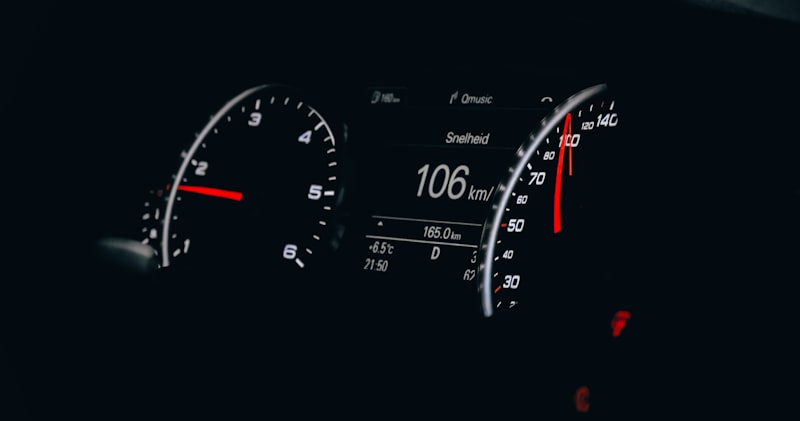
General tax education, not tax advice. Publication 463 and Schedule C Part IV (or Form 4562) want total miles for the year so business-use percentage is checkable. Dated odometer photos are a practical way to support those readings. They are not a substitute for a trip log, and they are not a required IRS form. Confirm the current instructions for the year you file.
If you drive for Uber, Lyft, DoorDash, or another 1099 app, the mileage deduction is usually the largest number on Schedule C. The IRS does not just want “business miles this year.” It wants total annual miles — business + commuting + other — so it can check the percentage. That is what Part IV (Information on Your Vehicle) is for. App-only yearly totals almost never have a denominator.
An odometer photo log is the bookend: a dated picture of the dash on January 1 and December 31 (or the start and end of business use), plus a few monthly snapshots so the year is not a story you invent in April. The photos prove how far the car actually moved. The five-field trip log still proves which of those miles were for work.
The short version: photograph the odometer at year-start and year-end, add a monthly snapshot, make sure each frame shows the date, the reading, and this vehicle, and keep a contemporaneous trip log next to the photos. Use the bookends for total miles and business-use %. Use 2026’s 72.5¢ / 76¢ split only on business miles by trip date — never on the odometer delta.
Step 1: Take a year-start odometer bookend photo
On January 1 — or the first day this car is used in the business this year — open the driver’s door, turn the ignition far enough to wake the cluster, and photograph the odometer. That number is the start of total annual miles.
If you placed the car in service mid-year, the bookend is the in-service date, not January 1. Part IV also asks when the vehicle was placed in service. The photo date and that answer should match. A second car needs its own bookends — do not photograph one dashboard and reuse the number: two cars or a mid-year switch.
Do this before the first paid trip of the year if you can. A photo taken after 400 January miles is still useful; it is just a weaker start. Write the reading in the same notebook or app you will use for trips so you are not hunting camera roll in March.
How you capture trips day to day is covered in how to track mileage for taxes. The photo is the yardstick those trips are measured against.
Step 2: Capture monthly mid-year snapshots
One January photo and one December photo is the minimum. Monthly snapshots are cheap insurance:
- A June 30 reading sits on the same day the 2026 rate changes. You still split business miles by trip date for the dollar math; the June photo is just another check that the odometer is moving at a believable pace.
- If the phone dies, you sell the car, or you switch vehicles, you are not reconstructing six silent months.
- A smooth monthly series is much harder to fake than two lonely numbers that happen to support a 95% business-use claim on a family SUV.
Pick a recurring cue: first oil-change of the month, first Sunday, or the same day you review unclassified trips. One extra photo. Thirty seconds.
If you sell or trade the car during the year, the closing bookend is the sale date, not December 31. That same yearly business-mile total later reduces basis; see selling a car after the standard mileage deduction.
Step 3: Make sure each photo shows date, reading, and the vehicle
A blurry close-up of some digits is not a record. Aim for all three:
| What to capture | Why it matters |
|---|---|
| Odometer reading (statute miles) | The year’s total-miles denominator. Use the main odometer, not Trip A/B unless you also show the main. |
| Date | Phone timestamp (keep original metadata), a dashboard clock, or a second shot of that day’s dated paper. A file named odometer.jpg with no date is a claim, not evidence. |
| Vehicle identifiable | Enough dash, steering wheel, or VIN plate that this is your car. Two cars in the household need two series. |
Digital clusters that hide the odometer until you cycle a menu: cycle it. Kilometers-only clusters: photograph the km reading and keep a one-line note of the conversion you used (1 mile = 1.60934 km). Do not silently switch units mid-year.
A screenshot of the trip app is not an odometer photo. Uber, Lyft, and DoorDash history can support some business trips. It does not show how far the car moved on grocery runs, school drop-off, or the commute. Part IV asks for those other miles on purpose.
Step 4: Pair the photos with a five-field trip log
Publication 463 still wants the same fields described in IRS mileage log requirements:
- Date
- Destination or route
- Business purpose
- Miles for that trip
- A way to show total annual mileage so business-use percentage is checkable — this is what the bookend photos are for
The odometer delta is not your business miles. If the car went from 48,210 to 66,410, that is 18,200 total miles. Business miles come from the trip list. Commuting and other miles are the rest. They should add up, within a few miles of rounding, to the photo delta.
Multi-app days still count once. If you are online on two platforms on the same drive to a hotspot, that is one trip. Purpose can name both apps. Stacking each app’s on-trip total will both double-count overlapping time and still miss deadhead. Platform history is evidence; it is not the log and it is not the odometer.
The commute rule does not disappear because you took a photo. Home to a regular workplace is personal. The first paid pickup after you go online, a reposition while you are working, and a supply run generally count. When that line is fuzzy, read business miles vs. commuting miles before you swipe everything as business.
Contemporaneous means at or near the time of the drive. Classifying trips the same day is the habit that makes the photo log honest. A February reconstruction from memory next to two December photos is still a reconstruction.
Step 5: Use bookends for total miles, not for the dollar rate
Business-use percentage = business miles ÷ total miles on that vehicle for the year. You need it for Part IV even on standard mileage. You need it again if you use actual expenses. A family car used for school, groceries, and weekend trips is not 100% business. Examiners know that.
On the current Schedule C, if you take car expenses on Line 9 and you are not required to file Form 4562, you complete Part IV: date placed in service; miles for business, commuting, and other; whether the car was available for personal use; whether you have another vehicle for personal use; and whether you have written evidence. Those answers have to match the photos and the log. Line 9 that implies 90% business next to Part IV miles that imply 40% is how a deduction gets pulled. The line-by-line map is in how to claim car expenses on Schedule C.
If you file Form 4562 (depreciation, section 179, or other listed property), the vehicle questions usually move to Form 4562 Part V. The odometer bookends still feed the same three mile buckets. App-only totals that never recorded personal trips cannot fill those buckets.
2026’s two business rates do not apply to the odometer delta:
| Number | What it is for | What it is not for |
|---|---|---|
| Year-end odometer − year-start odometer | Total miles (the Part IV denominator) | Multiplying by 72.5¢ or 76¢ |
| Business miles Jan 1 – Jun 30 | × 72.5¢ = first-half dollars | Total miles or commuting miles |
| Business miles Jul 1 – Dec 31 | × 76¢ = second-half dollars | The full-year odometer change |
| Line 9 (typical) | A + B, plus allowed extras such as business parking and tolls | One annual total × one rate |
Illustration only, not a promise: 18,200 total miles, 12,400 of them business (5,800 before July 1 and 6,600 after) is a business-use percentage of about 68%, and a standard-mileage deduction of $4,205 + $5,016 = $9,221 before extras. The same 18,200 × 76¢ would be the wrong number twice: it treats personal miles as business and it uses one rate for a two-rate year. Mechanics are in the July 1 rate-change explainer and the 2026 rate guide.
Parking and tolls on work trips can still sit on top of the standard rate; gas and insurance cannot. That split is parking and tolls with the standard mileage rate.
Step 6: Take the year-end bookend and archive the set
On December 31 — or the last day of business use if you sell the car or stop driving for work — photograph the odometer the same way you did in January. Same angle if you can. Same car.
You generally do not attach the photos or the trip list to an e-filed Schedule C. You keep them. If the return is examined, the log is the deduction. Export a dated trip list (PDF or CSV), keep the January and December photos (and the monthly set), and store them with the 2026 packet for at least several years. Seven is a common conservative habit after you file.
Name the files so a stranger can read them: 2026-01-01-odometer-48210.jpg, 2026-12-31-odometer-66410.jpg. Leave the original EXIF dates intact. Do not screenshot-and-crop until the digits are unreadable.
Step 7: Skip the reconstruction mistakes
- No year-end photo. A January shot and a story is half a bookend. Take December 31 even if you think the year was “all work.”
- Photo of the trip app, not the odometer. Platform screenshots support some trips. They do not show total miles.
- Reconstructed readings. “I think I started around 48,000” written in April is not contemporaneous. If you missed January, photograph today and backfill the start only from an inspection, repair order, or a photo you already had.
- Odometer delta treated as business miles. Total miles include commuting and personal. Part IV asks for the split on purpose.
- One 2026 rate on total miles. Rates apply to business miles by trip date. Bookends are the denominator.
- 100% business use of a household car with no commuting or other miles and no second vehicle for personal use. That claim needs a log that can hold it.
- Two cars, one photo series. Each vehicle has its own bookends and its own method. See standard mileage vs. actual expenses.
- Trip-A reset as the annual reading. Reset buttons are not the statute odometer.
If you already filed without a log, amending is a different job: how to amend if you missed the mileage deduction.
Keep the trip side of the bookends contemporaneous
TaxMiles: Mileage Tracker by Gigabyte LLC (App Store id 6758579463) auto-detects trips so you can classify business vs. personal the same day — the five fields next to your odometer photos. Not MileIQ. Not Everlance. Not Mileage Tracker for Taxes (id 6758426140). Free plan is 40 trips a month; Pro is $5.99/month, $39.99/year, or $79.99 lifetime.
Download TaxMiles FreeFrequently Asked Questions
Does the IRS require odometer photos?
No. It wants beginning and ending readings (and a trip log) so total miles and business-use % can be checked. Dated photos are how you show those readings were real and timely.
What should an odometer photo show?
The main odometer, a date, and enough of the car to identify it. Not a screenshot of a gig app.
Can I use only a mileage app total for Part IV?
Not if the app never recorded commuting and other miles. Part IV wants all three buckets. Bookends plus a log that marks personal trips fill them.
Do 72.5¢ and 76¢ apply to total miles?
No. Those 2026 rates apply only to business miles, split at June 30. See how to apply the 2026 rate change.
What if I missed the January 1 photo?
Photograph today. Backfill the start only from contemporaneous paper or an older photo. Start the monthly series now.
Related reading: IRS-ready log habit, what the log must include, Schedule C car expenses, how to track mileage, parking and tolls on top of the standard rate, and TaxMiles on the web.
This article is general tax education for U.S. federal Schedule C filers, not legal, tax, or accounting advice and not a guarantee of any deduction. Publication 463, Schedule C, Form 4562, Notice 2026-10, and Announcement 2026-11 can change; read the current IRS instructions or work with a licensed professional. TaxMiles: Mileage Tracker is published by Gigabyte LLC (App Store id 6758579463), is not affiliated with the IRS, and is not MileIQ, Everlance, or Mileage Tracker for Taxes (id 6758426140).